
The Great Pyramid is one of the most famous ancient pyramids in the world, located in Giza, Egypt. It was built approximately 4,500 years ago as the tomb of King Khufu. Its original height was about 146.5 meters, and it is estimated that approximately 2.3 million stone blocks were used in its construction. Although modern machinery did not exist at the time, the ancient Egyptians created this enormous structure through their hard work, craftsmanship, and engineering skills. Inside the pyramid are the Grand Gallery, the King’s Chamber, and other chambers. However, King Khufu’s mummy has never been found. Research is still underway to understand the exact construction techniques and certain internal spaces within the pyramid. There is no reliable scientific evidence that aliens built it. Even today, the Great Pyramid remains a remarkable example of ancient Egyptian architecture, history, and human capability.
The Great Pyramid of Giza: The Complete Story of King Khufu’s 4,500-Year-Old Pyramid.
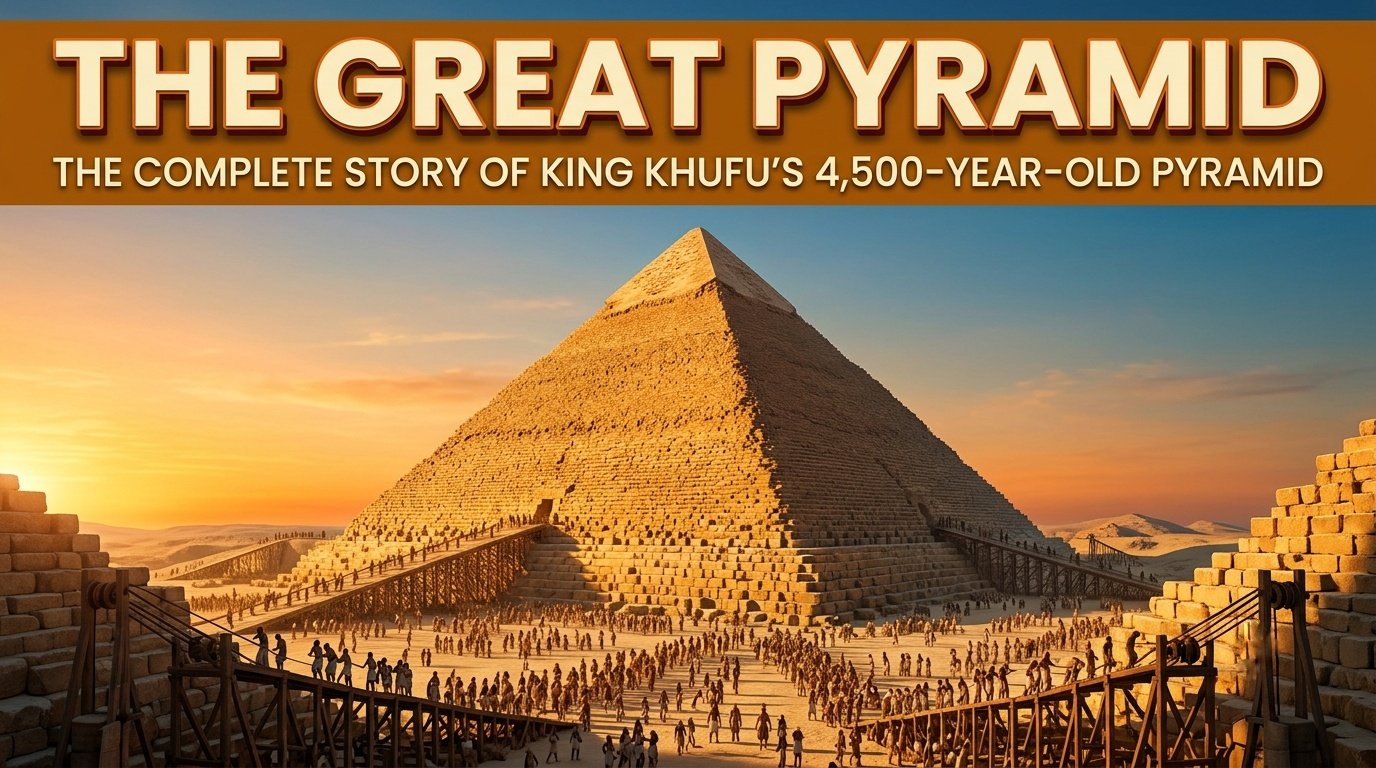
The Great Pyramid: An Overview
- The Great Pyramid is one of the world’s most famous ancient pyramids, located in Giza, Egypt.
- It was built approximately 4,500 years ago for King Khufu of Egypt’s Fourth Dynasty.
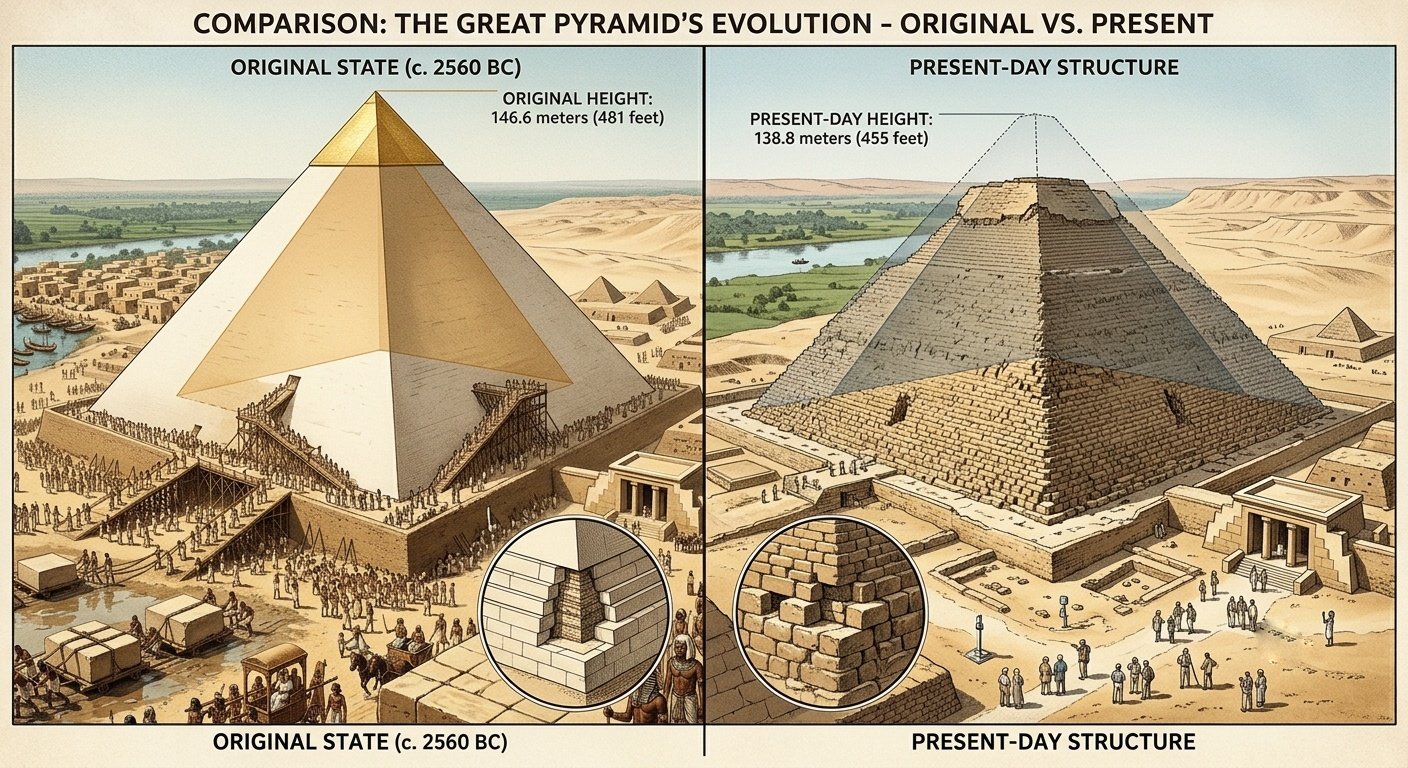
- Its original height was approximately 146.6 meters, which has decreased to around 138.5 meters today.
- It is estimated that approximately 2.3 million stone blocks were used in its construction.
- The exact construction methods remain uncertain, but ancient Egyptian engineering and organization played a major role in building it.
1. What Is the Great Pyramid?
Just think about it for a moment. Today, we have massive machines, cranes, trucks, computers, and modern engineering techniques. Even now, if someone proposed constructing a structure of this size, calculating the budget, workforce, and machinery requirements would be a tremendous challenge. Now imagine traveling back approximately 4,500 years. There were no trucks like the ones we use today, no electrically powered cranes, and no modern machinery. Despite these limitations, the Egyptians built an enormous stone structure that continues to amaze people worldwide. This monument is known as the Great Pyramid of Giza. It stands on the Giza Plateau, near Egypt’s capital, Cairo. In ancient Egyptian history, pyramids were not merely large buildings. They were connected to royal tombs, religious beliefs, and the ancient Egyptians’ understanding of life after death.
According to Egypt’s Ministry of Tourism and Antiquities, the Great Pyramid was built as the tomb of King Khufu. It is the oldest and largest of the three major pyramids at Giza.
Source: https://egymonuments.gov.eg/monuments/the-great-pyramid/
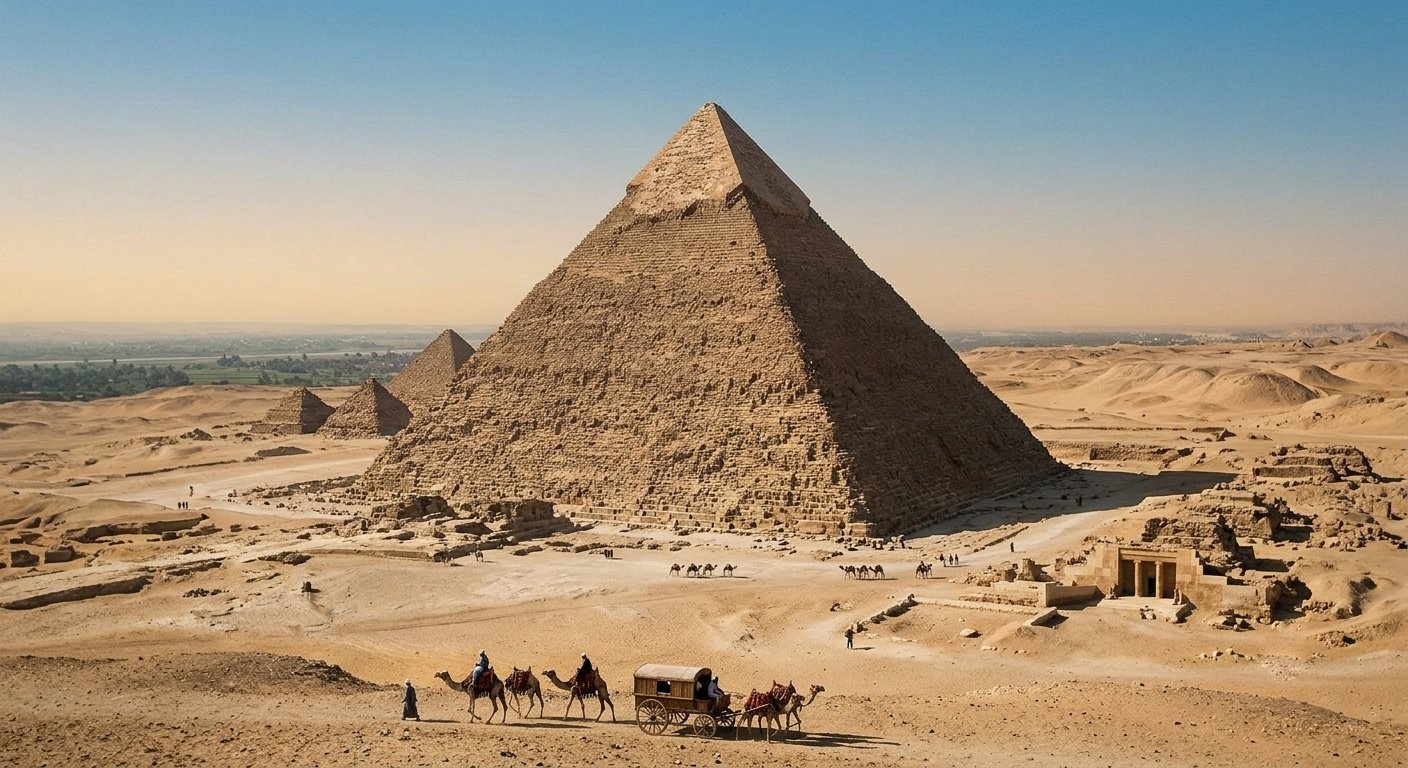
2. Who Was King Khufu?
The most important figure in this story is King Khufu. In ancient Greek historical accounts, he is also known as Cheops. Khufu was a ruler of Egypt’s Fourth Dynasty. His reign is generally dated to approximately 2589 BCE to 2566 BCE. In ancient Egypt, a pharaoh was not viewed simply as a king. According to Egyptian religious beliefs, the pharaoh held an exceptionally important position and was associated with the gods and the afterlife. Khufu commissioned a tomb that would preserve his power and identity even after his death. Building a royal tomb was not an ordinary undertaking in those days. It required gathering stones, organizing workers, arranging food supplies, and maintaining construction activities over an extended period. Interestingly, historians still know relatively little about Khufu’s personal life. His enormous monument is famous throughout the world, but historical information about the king himself remains limited. A small ivory statuette believed to represent Khufu has survived and is considered one of his best-known surviving depictions. It is interesting to think that the king who commissioned such a massive monument is represented by a statuette that is nowhere near the size of the monument itself.
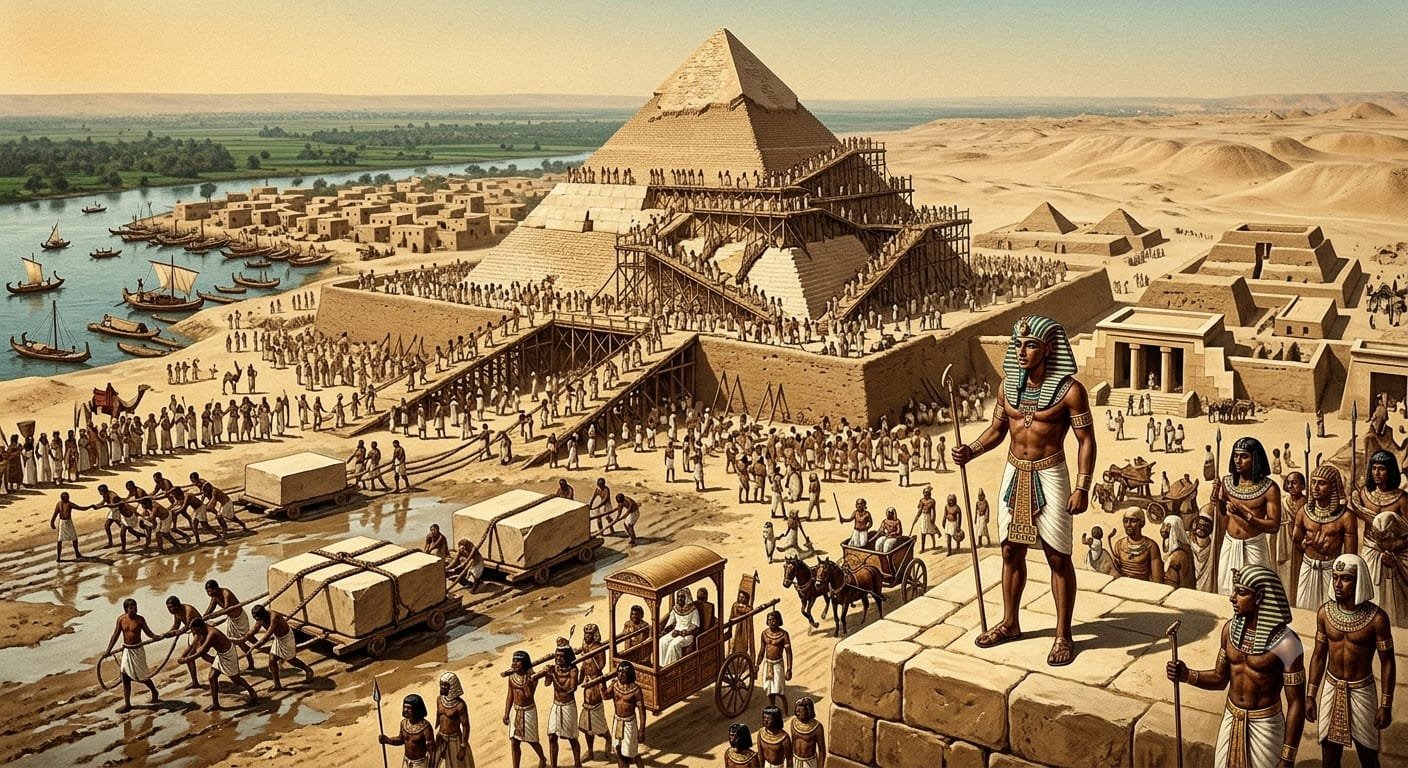
3. Why Was the Pyramid Built?
This raises an important question: Why did a king need such an enormous tomb? Could an ordinary burial place not have served the same purpose? The answer lies in the beliefs of ancient Egyptians. They did not regard death as the absolute end of existence. According to their religious beliefs, a person’s existence could continue in some form after death. For this reason, considerable attention was given to preserving royal bodies, burying essential belongings with the deceased, and constructing special tombs. The ancient Egyptian technique of preserving a body is known as mummification. Food, jewelry, pottery, and other objects were also placed in many royal tombs because of beliefs concerning the afterlife. The Great Pyramid was part of this religious and royal tradition. It was not simply a pile of stones but the central structure of a larger funerary complex. Smaller pyramids, temples, boat pits, and other tombs were located around it. This indicates that the surrounding area was developed according to a broader plan. However, it is important to understand that our knowledge of ancient Egyptian religious beliefs comes from archaeological evidence and ancient writings. It would be incorrect to assume that every individual living at that time held exactly the same beliefs.
4. How Large Is the Great Pyramid?
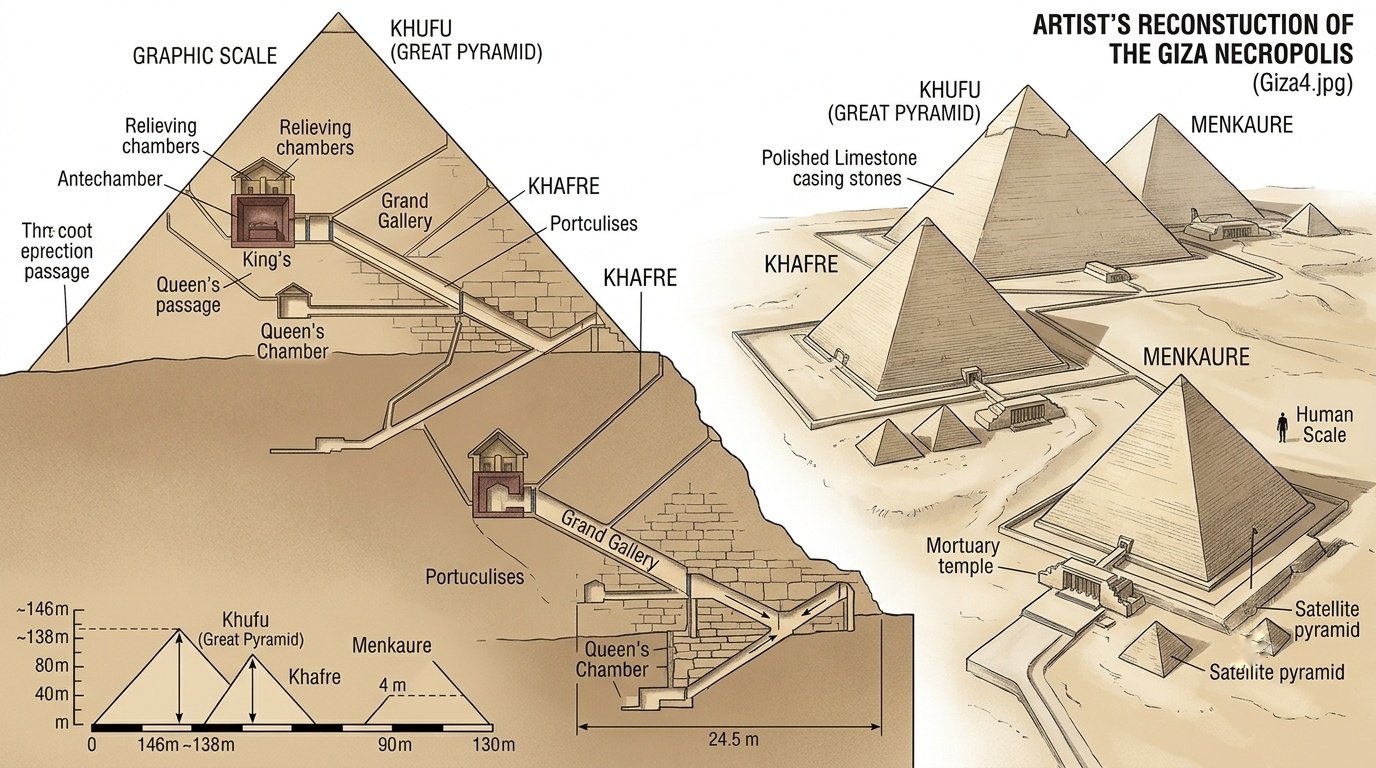
Now let’s examine the feature that makes this pyramid stand out: its enormous size. According to Egypt’s Ministry of Tourism and Antiquities, the Great Pyramid originally stood approximately 146.5 meters tall. Today, its remaining structure measures around 138.5 meters in height. To understand its scale, imagine a very tall modern building. The remarkable difference is that the pyramid was constructed approximately 4,500 years ago.
Important Facts About the Pyramid
- Name: Great Pyramid of Giza
- King: Khufu
- Location: Giza, Egypt
- Period of Construction: Approximately the 26th century BCE
- Original Height: Approximately 146.5 meters
- Current Height: Approximately 138.5 meters
- Length of Each Base Side: Approximately 230 meters
- Estimated Number of Stone Blocks: Approximately 2.3 million
- Main Construction Materials: Limestone and granite
- Estimated Construction Time: Approximately 10 to 20 years
The construction period and the number of stones are estimates. No complete record has been discovered documenting every stone used or every day of construction.
Why Is the Pyramid Shorter Today?
When the pyramid was newly built, its exterior was covered with a layer of smooth, light-colored limestone. From a distance, its surface would have looked much smoother than the rough stone exterior visible today. Over time, much of the outer casing disappeared. Some stones were reused in later construction projects, while natural weathering and deterioration also contributed to the changes. As a result, the pyramid no longer looks as it originally did. Nevertheless, its main structure has survived for thousands of years.
5. How Was It Actually Built?
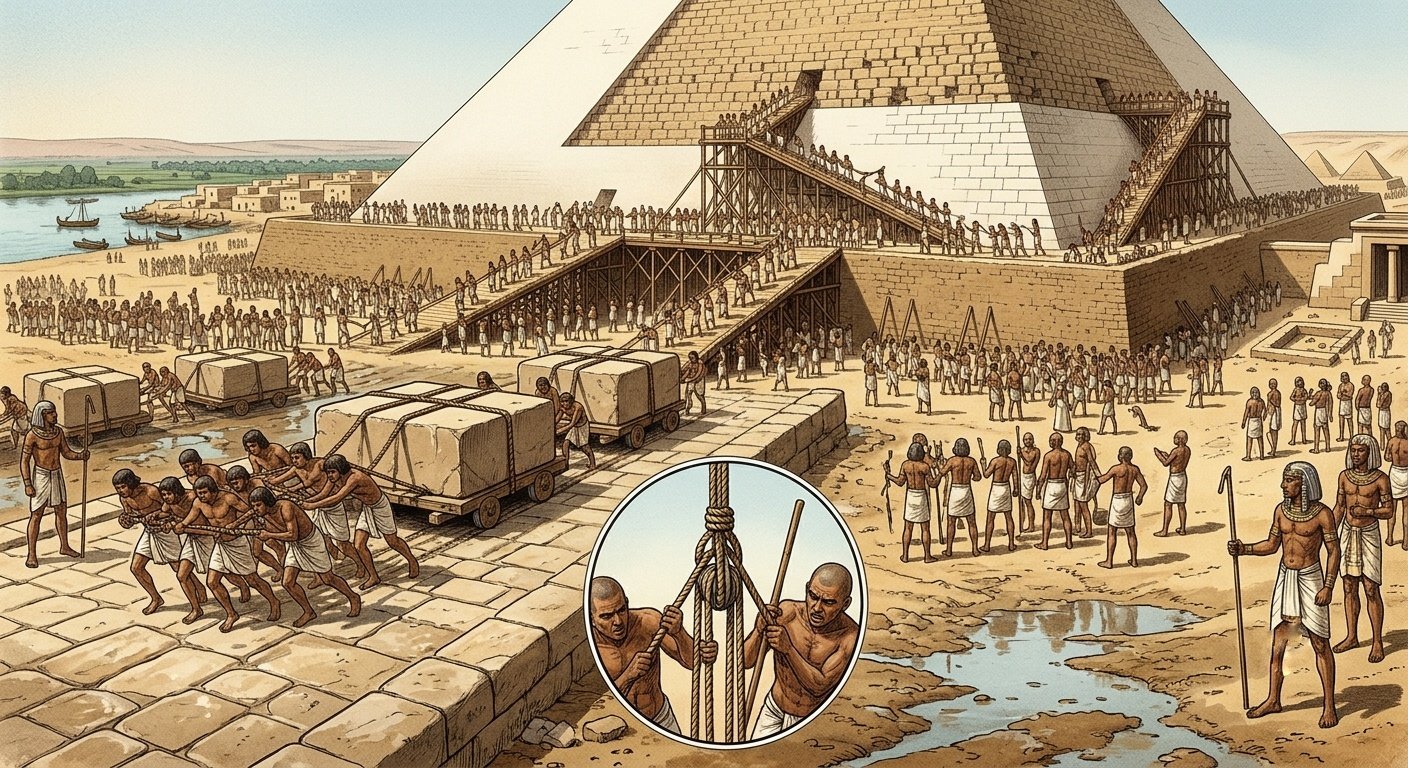
This is the question that historians, archaeologists, and engineers have been investigating for a long time. Building such a massive structure required much more than physical strength. It required stonecutters, transport workers, people skilled in measurement, food suppliers, and officials capable of managing the entire operation.
Where Did the Stones Come From?
Most of the main stones used in the pyramid were quarried from areas around Giza. Some of the higher-quality limestone used for the outer casing was brought from Tura. Granite used in certain interior sections is believed to have been transported from the distant Aswan region. It is important to remember that not every stone needed to be transported over a long distance. Locally available stone would have made transportation easier, while materials from other regions were used for specific parts of the structure.
How Were Heavy Stones Transported Upward?
Cutting the stones was challenging, but lifting them to greater heights must have been an even more difficult task. Archaeologists believe that stones may have been placed on wooden sledges and dragged to their destinations. Preparing the routes, organizing teams of workers, and establishing an efficient transportation system would have been essential. Ramps made from earth, mudbrick, or stone may have been used to move the blocks upward. However, the precise design of the ramps used during construction remains uncertain. Different methods may have been employed at different stages of construction. There is no conclusive evidence that a single ramp was used for the entire pyramid.
How Were So Many Stones Positioned Correctly?
The pyramid’s stability depended on more than the number of stones used. Accurate measurements, leveling the ground, and maintaining the balance of the structure were equally important. Ancient Egyptian craftsmen possessed practical knowledge of the sun, stars, directions, and measurement. Despite lacking modern instruments, they created a structure whose sides are remarkably well aligned with the cardinal directions. This was not the result of magic. It was likely achieved through sustained labor, practical experience, skilled craftsmanship, and organized planning.
6. What Is Inside the Great Pyramid?
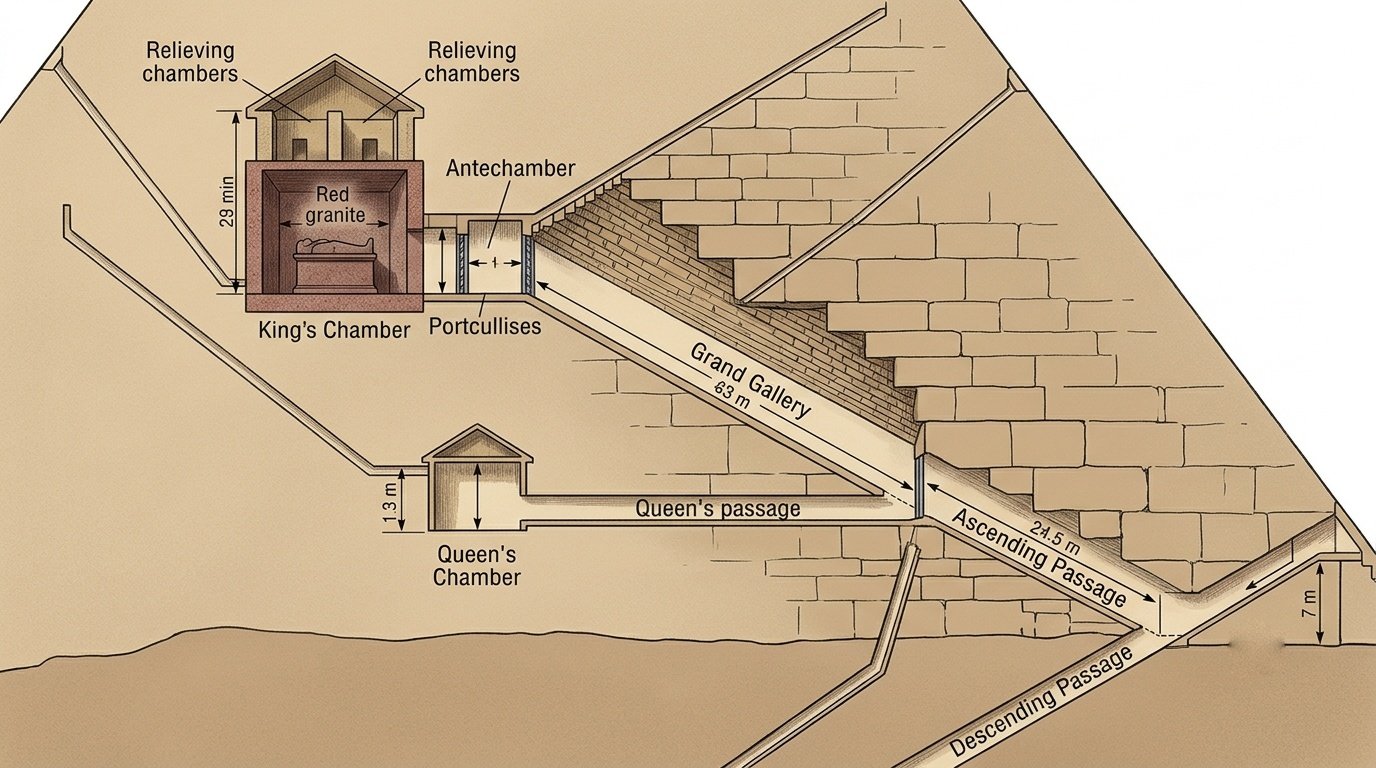
From the outside, the Great Pyramid resembles a solid mountain of stone. However, its interior contains passages, corridors, and several chambers. According to the official monument description provided by Egypt, the pyramid contains three principal chambers. One was cut into the bedrock below the pyramid, while the other two are situated higher within the structure.
The Grand Gallery
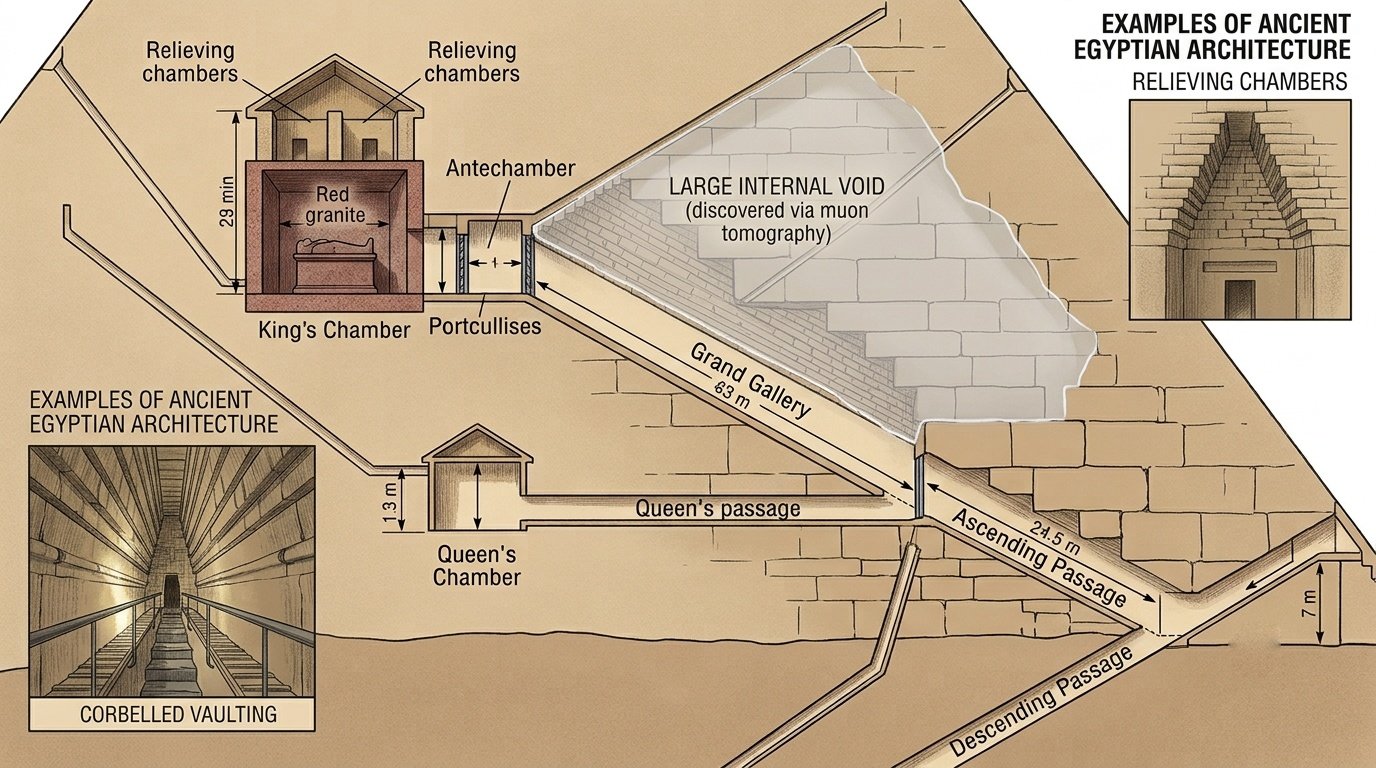
Inside the pyramid is a long, tall passage known as the Grand Gallery. Its design is considered an impressive example of ancient engineering. The gallery forms part of the route leading toward the chambers located higher inside the pyramid. The arrangement of its ceiling and walls demonstrates the builders’ understanding of how to manage the weight of large stone structures.
The King’s Chamber
This room is known as the King’s Chamber. Inside it is a large stone sarcophagus made of granite, which is associated with King Khufu. However, Khufu’s mummy has not been found in the chamber. Therefore, it would be incorrect to claim that his mummy is still lying there. The chamber’s design and the presence of the sarcophagus provide strong indications that the pyramid was intended to serve as a royal tomb.
The Unfinished Underground Chamber
There is also a chamber beneath the ground inside the pyramid. Its design and unfinished appearance raise several questions. There is no complete agreement about its original purpose. The construction plan may have changed during the building process, but it is difficult to provide a definitive answer. This uncertainty is one of the reasons the pyramid’s interior continues to attract interest.
7. Was the Great Pyramid Built by Slaves?
When people hear the story of the pyramid, many imagine thousands of slaves, soldiers carrying whips, and a king forcing people to work. However, the historical picture is more complicated. The ancient Greek historian Herodotus wrote about pyramid construction long after the Great Pyramid had been built. His account mentions 100,000 workers. However, he visited Egypt approximately two thousand years after the pyramid’s construction. Therefore, his figure cannot be treated as a definitive construction record. Modern archaeological evidence has revealed settlements associated with pyramid workers, traces of their activities, and evidence of food supplies. Based on these findings, historians believe that organized laborers and skilled craftsmen played a major role in construction.
What Might the Workers’ Lives Have Been Like?
A project of this scale required food, water, accommodation, and tools for the people involved. Workers would likely have been assigned different responsibilities. Some may have cut stones in quarries, others may have transported them, and still others may have positioned them in the structure. Some workers may have worked throughout the year, while others may have participated during particular seasons or for limited periods. Agricultural seasons and the water levels of the Nile River may also have affected the availability of workers. This does not mean that every worker enjoyed comfortable conditions. Heavy physical labor, injuries, and difficult working conditions were probably common. However, there is insufficient evidence to claim that all the workers were slaves.
8. Seven Major Mysteries of the Great Pyramid
Several aspects of this monument remain incompletely understood. Some questions are supported by substantial evidence, while others continue to be investigated.
1. How Many Years Did Construction Take?
According to Egypt’s Ministry of Tourism and Antiquities, construction is estimated to have taken approximately 10 to 20 years. However, no complete construction record has been discovered documenting the starting date, the duration of every stage, and the date when the final stone was placed. Therefore, the estimate of 20 years or less is not a conclusively established date.
2. How Were So Many Stones Managed?
Approximately 2.3 million stone blocks are estimated to have been used in the pyramid. Cutting, transporting, and positioning every block was a major undertaking. If thousands of workers were working simultaneously, the correct materials needed to reach the correct locations at the right time. A delay in stone delivery could have interrupted the next stage of construction. Therefore, the real achievement was not simply moving heavy stones but also organizing the entire operation efficiently.
3. How Were Its Directions Determined So Accurately?
The sides of the pyramid are aligned almost parallel to the cardinal directions. Achieving such accurate alignment without modern compasses or satellites demonstrates the knowledge possessed by ancient Egyptians. They may have used the position of the sun, the stars, and shadows to determine directions. However, different theories exist regarding the precise methods they employed.
4. Why Were the Interior Chambers Built?
The pyramid contains three principal chambers, but the reasons behind every construction decision are not fully understood. The underground chamber appears unfinished, while the upper chambers have distinctive architectural features. The construction plan may have changed during the building process. New surveys and archaeological studies may provide further information, but it would be incorrect to assume that every unexplained space contains a secret treasure.
5. Where Is the King’s Mummy?
A stone sarcophagus remains in the King’s Chamber, but Khufu’s mummy has not been found there. It is possible that the tomb was robbed in ancient times. Many royal tombs in ancient Egypt were targeted by tomb robbers. Nevertheless, there is no definitive answer explaining exactly what happened to Khufu’s mummy.
6. Why Are There Empty Spaces Inside the Pyramid?
Modern scanning technologies have revealed previously unknown large spaces inside the pyramid. In 2017, research announced by the ScanPyramids project identified a large void within the structure. However, discovering an empty space does not automatically prove the existence of a hidden treasure or a new chamber. Further research is required to understand its purpose.
7. How Has It Survived for Thousands of Years?
The pyramid’s massive base, broad lower structure, and arrangement of stones contribute to its stability. Its exterior has changed considerably over time, but the main structure remains standing.This suggests that the builders carefully considered weight distribution and structural strength. Perhaps the most remarkable aspect of these mysteries is that many historical questions have been answered, while others continue to be investigated.
9. Did Aliens Build the Great Pyramid?
Claims frequently appear on the internet suggesting that humans could not have built such a massive structure. Some people connect the pyramid to aliens, while others attribute it to a lost, technologically advanced civilization. These stories may sound exciting, but an exciting claim and a true claim are two different things. Archaeological evidence found around the pyramid, traces of quarries, evidence associated with construction workers, and other ancient Egyptian monuments demonstrate that a developed building tradition existed in Egypt. The Egyptians were capable of performing calculations, taking measurements, cutting stones, and organizing large-scale projects. They did not possess modern machinery, but that does not mean they lacked technical knowledge. To date, there is no reliable scientific evidence that aliens built the pyramid. Therefore, whenever a video claims that the pyramid’s mystery has been completely solved or that aliens definitely constructed it, examine the evidence supporting the claim. Asking questions about history is a good thing, but answers must also be supported by evidence.
10. Comparison with Other Egyptian Pyramids
The Giza Plateau is not home to just one pyramid. It contains three major pyramids associated with different Egyptian kings.
Comparison of the Three Major Pyramids
King Khufu’s Pyramid
- English Name: Great Pyramid
- Built For: King Khufu
- Size: The largest of the three
- Construction Period: Fourth Dynasty
- Distinctive Feature: Historically recognized as one of the tallest structures of the ancient world
King Khafre’s Pyramid
- English Name: Pyramid of Khafre
- Built For: King Khafre
- Size: The second-largest of the three
- Construction Period: Fourth Dynasty
- Distinctive Feature: Its elevated position makes it appear particularly tall when viewed from a distance
King Menkaure’s Pyramid
- English Name: Pyramid of Menkaure
- Built For: King Menkaure
- Size: The smallest of the three
- Construction Period: Fourth Dynasty
- Distinctive Feature: Smaller in size but part of the same royal building tradition
Khafre was the son of Khufu, while Menkaure ruled later. Together, these three pyramids demonstrate that large royal construction projects in ancient Egypt were not limited to a single king.
11. Advantages and Disadvantages of the Great Pyramid
The advantages and disadvantages of a historical monument should not be evaluated in the same way as those of a modern house or building. In this case, the discussion concerns the society of that period, royal authority, and the effects of the labor required to construct the monument.
Advantages and Achievements
- An outstanding example of engineering: The pyramid demonstrates the skills required to cut and transport stones and maintain the stability of an enormous structure.
- A source of information about ancient Egypt: It helps us understand the religious beliefs, monarchy, and construction systems of the period.
- Historical heritage: Thousands of years later, it remains an important symbol of ancient Egyptian civilization.
- Importance for modern tourism: Visitors from around the world travel to see the pyramid, benefiting local tourism and related businesses.
- Opportunities for scientific research: Modern scanning techniques and archaeology may reveal additional information about the monument.
Disadvantages and Challenges
- Demanding physical labor: Workers involved in the construction would have faced difficult physical tasks.
- Resource requirements: Organizing stone, tools, food, water, and workers required an enormous logistical effort.
- The influence of royal authority: Large royal projects also reflected the power of the state and its control over resources.
- The tomb was not permanently protected: Despite its enormous size, the pyramid could not guarantee that the royal burial would remain safe from tomb robbers.
- Changes to its original appearance: The loss of much of the outer casing means that its original smooth and bright appearance is no longer visible.
We can admire the achievements represented by the pyramid while also recognizing the labor and social organization that made its construction possible.
12. History and Modern Reality: The True Importance of the Great Pyramid
Understanding a historical site requires more than looking at its height or size. We must also consider its influence on human understanding and history. Today, the Great Pyramid is an important part of Egypt’s identity. People from different countries visit it for many reasons. Some want to understand its architecture, others want to learn about King Khufu, and many are fascinated by its interior chambers.
Does It Still Generate Income Today?
Yes. The Giza pyramid complex is important to Egypt’s tourism industry. Tour guides, hotels, transportation services, restaurants, and other tourism-related businesses operate in the surrounding area. However, it would be incorrect to assume that every local resident earns the same amount from tourism. Some people may earn a good income, while others may depend on seasonal or uncertain work. Tickets and separate entry requirements may apply to different areas of the pyramid complex. If you are planning a visit, check the latest ticket prices, opening hours, and entry requirements on the official website of Egypt’s Ministry of Tourism and Antiquities before traveling.
Official Website: https://egymonuments.gov.eg/
Why Is Preserving History Important?
Imagine that your village has a 300-year-old mansion containing objects and memories from the time of your great-grandparents. If someone demolished it without considering its historical value, not only would the walls disappear, but an important part of your area’s history would also be lost. The same principle applies to the Great Pyramid, except that its history stretches back thousands of years. Preserving such places allows future generations to understand how people lived in ancient times, what they believed, and how they accomplished great things despite having limited resources.
13. What Can We Learn from the Great Pyramid?
The value of studying history goes beyond writing answers in an examination. It can also teach us important lessons about our work and our lives.
1. Major achievements require planning.
Building the pyramid required more than the physical strength of workers. Every task, from obtaining stones to positioning them correctly, had to be organized.
2. Skills and expertise matter.
Stonecutters, people skilled in measurement, and officials responsible for managing the work would each have played important roles.
Every responsibility matters when a large project is undertaken.
3. Technology is not limited to machines.
Today, we have modern equipment, but people in ancient times developed methods suited to the resources available to them.
Their knowledge and experience were also forms of technology.
4. Not every mystery can be solved immediately.
Some questions can only be answered when sufficient evidence becomes available.
Accepting assumptions as facts can make history more confusing rather than helping us understand it.
14. Frequently Asked Questions (FAQs)
Q1. Where Is the Great Pyramid Located?
The Great Pyramid is located on the Giza Plateau in Egypt, near Cairo. It is the largest of the three major pyramids at Giza.
Q2. Who Built the Great Pyramid?
The Great Pyramid was commissioned by King Khufu of Egypt’s Fourth Dynasty as his tomb. His Greek name, Cheops, is also widely known.
Q3. How Old Is the Great Pyramid?
The Great Pyramid is approximately 4,500 years old. Its construction is generally dated to around the 26th century BCE.
Q4. How Many Stones Were Used in the Great Pyramid?
It is commonly estimated that approximately 2.3 million stone blocks were used in its construction. However, no complete ancient record documenting the exact count is available.
Q5. Was the Great Pyramid Built by Slaves?
It is incorrect to describe all the builders as slaves. Archaeological evidence indicates that organized laborers and skilled craftsmen played important roles in the construction.
Complete information about the social status of every person involved is not available.
Q6. Is King Khufu’s Mummy Inside the Great Pyramid?
No. Khufu’s mummy has not been found inside the pyramid. A stone sarcophagus remains in the King’s Chamber, but the location of the king’s body is unknown.
Q7. Has the Mystery of the Great Pyramid Been Completely Solved?
No. Much is known about the pyramid’s purpose and construction, but research continues into questions such as the precise methods used to move stones upward and the purpose of certain internal voids.
Q8. Did Aliens Build the Great Pyramid?
There is no reliable scientific evidence supporting this claim. The available archaeological evidence points toward ancient Egyptian construction skills and the involvement of organized workers.
Sources and Further Reading
- Egypt’s Ministry of Tourism and Antiquities — The Great Pyramid:
https://egymonuments.gov.eg/monuments/the-great-pyramid/ - Smithsonian Institution — Ancient Egypt and the Pyramids:
https://www.si.edu/spotlight/ancient-egypt/pyramid - Khan Academy — The Old Kingdom Pyramid of Khufu:
https://www.khanacademy.org/humanities/ap-art-history/ancient-mediterranean-ap/a/old-kingdom-pyramid-of-khufu
Additional Note from the Original Document: D. B. Cooper Mystery